NEWS

Further specifications on the GKV-FinStG law

  • Published at 10.11.2022
  • Reading time 2 Min.

In their 2nd and 3rd reading, the German Parliament has decided further specifications of the new law on the financial stabilisation of the statutory health insurances (GKV-FinStG).

As already outlined in the draft of the law, the outcome of the AMNOG benefit assessment will further gain importance for the subsequent price negotiations. In case the appropriate comparative therapy (ACT) is patent-protected, a premium price will only be possible for products with a considerable or major added benefit. If the patent-protected ACT has not been subjected to AMNOG benefit assessment itself, further rebates will be applied. For ACTs that are not patent-protected, there are no changes, and products with an added benefit of any extent can achieve premium prices. Furthermore, only products with considerable or major added benefit will be exempted from the mandatory 20 % discount if they are used in combination with other drugs.

Currently, the added benefit of orphan drugs is proven by their market authorization and submission of a full AMNOG dossier is not necessary as long as the annual sales do not exceed 50M €. The initial draft of the GKV-FinStG law proposed a reduction of this threshold to 20M €. However, this threshold has now been increased to 30M €. The German Parliament estimates that approximately 10 orphan drug products will need to undergo reassessment after implementation of the law.


The outcome of the AMNOG benefit assessment will gain importance for the subsequent price negotiations.
More posts

Deep Dive: Price-Volume Model (§130b)

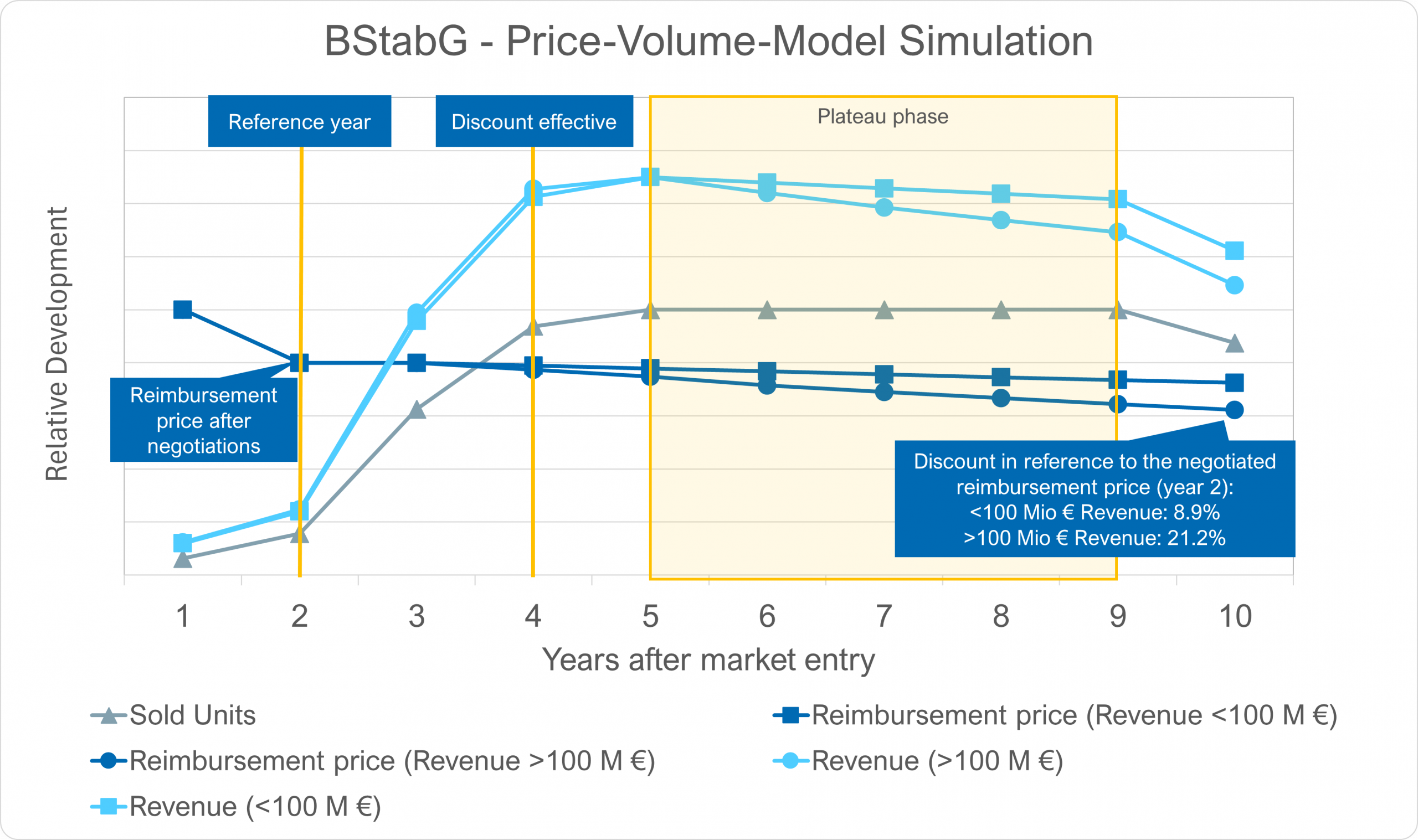
The price-volume regulation shall no longer be subject to arbitration. The default mechanism kicks in if no agreement between the pharmaceutical company and the statutory health insurances is reached and adjusts the reimbursement amount annually (starting in the third calendar year after launch) usi…

Read post

Draft Bill BStabG: What Matters for Pharmaceutical Companies now

The current draft bill on statutory health insurance contribution rate stabilization (BStabG) sets out the health policy objective of tighter expenditure control — with direct implications for pricing, market access, and reimbursement in the German market. An overview of the key changes for innovati…

Read post

Pediatric drug shortages

Pediatric drug shortages: has the situation really improved? In recent years, Germany has faced shortages of essential medicines for children, including antipyretics and antibiotics. To encourage manufacturers to increase production and supply, the GKV-SV (GKV-Spitzenverband, German SHI association)…

Read post

Start of EU-HTA: First Joint Assessments with IQWiG Involvement

Since the beginning of 2025, member states of the European Economic Area (EEA) have been working together on joint clinical assessments (JCA) of new medicines. Recently, the first 9 JCAs were announced, assessing 2 ATMPs with Orphan drug status and 7 oncologics. Germany, France, and Ireland are curr…

Read post